Previous Month | RSS/XML | Current
WEBLOG
October 21st, 2026 (Permalink)
There's a Sucker Born Every Second1
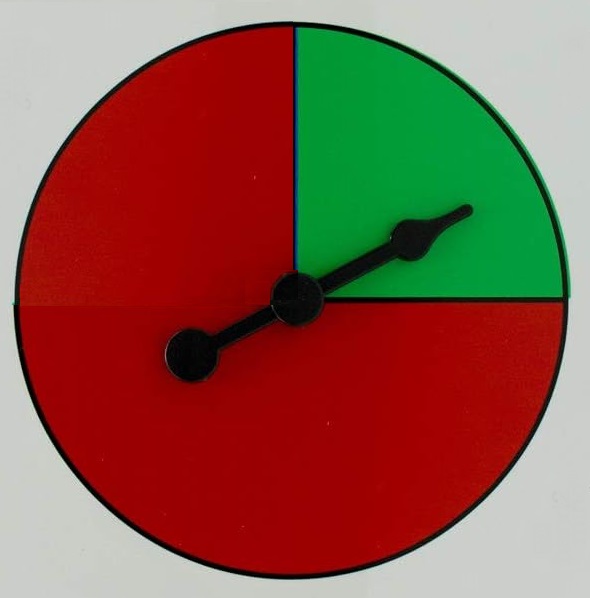
On a cool autumn day, Montgomery Banks2 was back at the carnival, and this time he had a spinner on top of his counter. The circular face of the spinner was divided into two sections, as shown: a large red section, making up three-fourths of the spinner's face, and a small green section accounting for the remaining one-fourth of the face. Attached to the center of the spinner was a rotating pointer.
"Step right up, sir or madam, as the case may be," he said to the crowd strolling past his booth, "and take it for a spin. Looky here, this spinner is completely fair and you can even spin it yourself. If you do and the arrow stops on the green section, you win a dollar; if it stops on the red section, you lose a dollar.
"Now, I know what you're thinking. There's only a one-quarter chance of you winning a spin, which means there's a three-quarter chance of losing, but I'm offering you an even-money bet. That ain't a fair bet, is it? No, sir.
"I tell you what I'm gonna do: If you don't win on the first spin, I'll let you try again, and if it stops in the green the second time, you win a buck. That's right, a second spin at no additional charge! That's two spins for a buck, and if you get in the green on either spin, you win. Two times one-quarter is one-half, so that's a fair bet, ain't it?"
Is the bet that Monty's offering fair at even money? Would you be a "sucker" to take the bet?
Extra Credit: If the bet is not fair, what is the real probability that the player will win?
What is the probability of the player losing both spins?
No―and this should be unnecessary to say―the bet isn't fair.
Explanation: Monty is correct that 2 × ¼ = ½, but that's not the right way to figure the probability of winning this bet. The easiest way to determine the probability of winning a bet that involves more than one trial is to figure the likelihood of losing each trial, then the probability of winning at least one trial is one minus that of losing each trial. Since the probability of losing a single spin is ¾, and the spins are independent of each other―that is, whether you win or lose a spin doesn't affect another spin―the probability of losing both spins is ¾ × ¾ = 9/16. Therefore, the probability of winning at least once is 1 − 9/16 = 7/16. A fair bet would be 8/16 = ½, so Monty's advantage in this bet is 1/16, or 6.25%.
Disclaimer & Disclosure: Like Monty, the above story is fictional. I came across a version of this gamble in Steven E. Landsburg's book Can You Outsmart an Economist? (2018), puzzle 2.
Notes:
- ↑ They used to say "There's a sucker born every minute", but since then there's been sucker inflation. The original quote is routinely attributed―to paraphrase Ralph Keyes―to P. T. Barnum, though he probably didn't say it; see: Keyes, The Quote Verifier: Who Said What, Where, and When (2006), p. 215.
- ↑ In case you don't know Monty, he is a trickster who always speaks the truth and nothing but the truth, but he seldom speaks the whole truth. Also, he never uses sleight-of-hand or gimmicks of any kind. For previous puzzles involving Monty, see:
- Three-Card Monty, 4/19/2018
- The Four Ace Puzzle, 6/24/2018
- A Valentine's Day Puzzle, 2/14/2019
- Three-Dice Monty, 3/12/2019
- For All the Marbles, 2/6/2021
- The Return of Three-Dice Monty, 8/4/2021
- The Return of Three-Card Monty, 9/1/2024
- "Never Give a Sucker an Even Break", 1/5/2026